Introduction
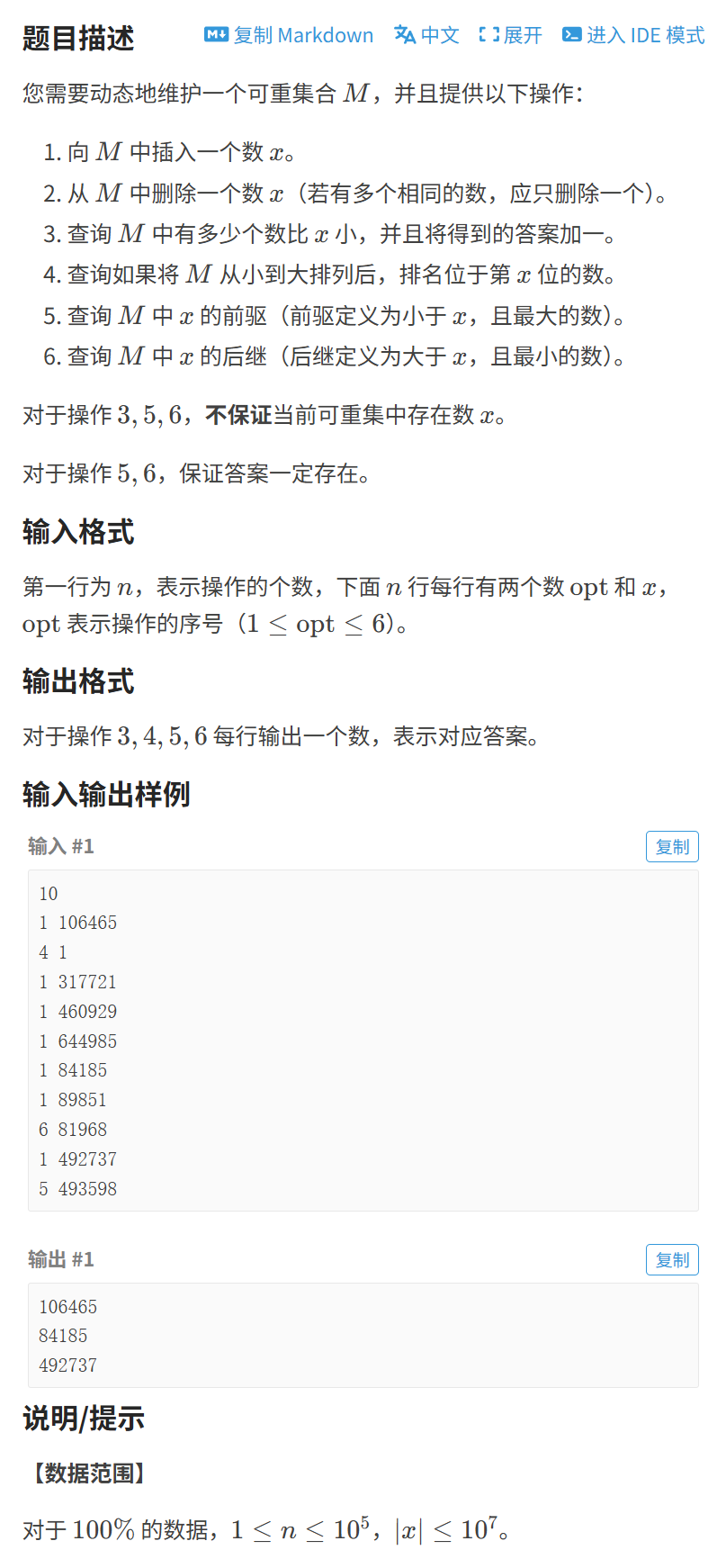
P3369 [Template] Ordinary Balanced Tree is a classic data-structure template problem. The usual solutions use a Treap, Splay tree, fhq Treap, or pbds.
This article records an unconventional implementation: maintaining an ordered multiset with a binary trie (01Trie).
As long as the value domain is manageable, all six operations required by the problem:
- Insertion
- Deletion
- Rank queries
- Finding the th smallest element
- Predecessor queries
- Successor queries
can be implemented using counts stored in the trie.
1. What the Problem Really Requires
We need to maintain a multiset that supports order statistics.
The problem does not inherently require a “balanced tree”; it requires us to maintain:
- The ordering of the elements in the collection.
- How many elements precede a given value.
- Which value corresponds to a given rank.
If a binary trie tracks “how many elements pass through each node,” it can support these operations.
2. The Core Idea
A binary trie is built from the most significant bit down to the least significant bit:
- The left child represents a 0 at the current bit.
- The right child represents a 1 at the current bit.
When the higher-bit prefix is the same:
Every number in the left subtree is smaller than every number in the right subtree.
The trie therefore has a form of “local ordering.”
If we also track how many elements pass through each node, we can support the same operations as an order-statistic tree:
- Count elements strictly smaller than a given value.
- Find the th smallest element.
Predecessors and successors can then be derived from these two operations.
3. Shifting the Value Domain
The code uses:
1 | const int offset = 1e7; |
Every input value is shifted to:
1 | x + offset |
This maps any potentially negative values into a nonnegative range, making it convenient to maintain them in the trie using ordinary binary representations.
If the original range is:
then the shifted range is:
Subtract offset when outputting an answer to recover the original value.
4. Choosing the Bit Width
The code iterates over bits as follows:
1 | for (int i = 25; i >= 0; --i) |
The maximum shifted value is approximately , and:
Thus, using bits 25 through 0, for a total of 26 bits, is sufficient to cover all possible values.
5. The Information We Maintain
The core arrays are:
1 | int trie[maxn][2], cnt[maxn]; |
Their meanings are:
trie[p][0]: the 0-child of nodep.trie[p][1]: the 1-child of nodep.cnt[p]: the number of elements passing through nodep.
We can interpret cnt[p] as:
The total number of elements in the subtree rooted at this node that pass through this prefix.
Since every number follows a full path of exactly 26 levels, no separate terminal marker is needed.
6. Insertion and Deletion
1. Insertion
1 | void Insert(int x) { |
Extract each bit from highest to lowest:
- Create the corresponding child if it does not exist.
- Follow the path downward.
- Increment the count of each node visited.
After insertion, the counts of all nodes along the path for x are correctly maintained.
2. Deletion
1 | void Delete(int x) { |
For deletion, follow the original path and decrement cnt at each node.
There is no need to physically remove nodes; keeping the counts correct is enough.
This implementation assumes that the problem guarantees valid deletions: the element to be deleted is present.
7. Rank Queries: getRank
The code is:
1 | int getRank(int x) { |
This function returns something different from the “rank” defined in the statement:
The number of elements strictly smaller than
x.
The main function therefore outputs the following for a rank query:
1 | getRank(x + offset) + 1 |
Correctness Analysis
Consider the current bit, working from highest to lowest.
Let its value be v:
When v = 0
Any number with a 1 at the current bit and the same higher-bit prefix must be greater than x.
It therefore contributes nothing to the count of elements smaller than x. Continue directly along the 0-branch.
When v = 1
Every number with the same higher-bit prefix as x but a 0 at the current bit must be strictly smaller than x.
We can therefore add the whole count directly:
1 | rank += cnt[trie[p][0]]; |
Then continue down the 1-branch to count the remaining possibilities.
Early Exit
If p becomes 0 at any step, the current prefix does not exist. No lower bits can contribute anything further, so we can stop immediately.
8. Finding the th Smallest Element: getVal
The code is:
1 | int getVal(int x) { |
This function returns the xth smallest element in the current collection, with x being 1-based.
Correctness Analysis
At any trie node:
- The left subtree has a 0 at the current bit.
- The right subtree has a 1 at the current bit.
Since 0 < 1 at the current bit, every element in the left subtree is smaller than every element in the right subtree.
Therefore:
- If the left subtree has at least
xelements, thexth smallest must be in that subtree. - Otherwise, it must be in the right subtree, and we subtract the number of elements in the left subtree from
x.
When moving into the right subtree, set the current bit to 1:
1 | val |= 1 << i; |
This eventually constructs the complete value.
9. Predecessors and Successors
1. Predecessor
1 | int getPrev(int x) { |
The predecessor is defined as “the greatest value strictly smaller than x.”
If there are k elements strictly smaller than x, the largest of those is exactly the kth smallest element. Thus:
2. Successor
1 | int getNext(int x) { |
The successor is defined as “the smallest value strictly greater than x.”
Since getRank(y) returns the number of elements strictly smaller than y:
Therefore:
1 | getRank(x + 1) |
is the number of elements in the collection that are less than or equal to x.
The rank of the smallest element strictly greater than x is then:
1 | getRank(x + 1) + 1 |
Use getVal to retrieve the corresponding value.
10. Mapping Operations in the Main Function
1 | if (op == 1) { |
The operations mean:
1 x: Insertx.2 x: Delete one occurrence ofx.3 x: Query the rank ofx.4 x: Query thexth smallest value.5 x: Query the predecessor ofx.6 x: Query the successor ofx.
Since the trie stores shifted values, subtract offset whenever outputting an actual value.
11. Complexity Analysis
Let the size of the value domain be .
Every operation only needs to follow the trie from the highest bit to the lowest. The time complexities are therefore:
- Insertion:
- Deletion:
- Rank query:
- th-smallest query:
- Predecessor query:
- Successor query:
Here, the value domain uses a fixed width of 26 bits, giving each operation a small constant factor.
For space complexity, inserting a new number may create 26 nodes in the worst case.
For around operations, we need approximately:
nodes, so the code defines:
1 | const int maxn = 2.6e6; |
12. Complete Code and Submission Record
Expand/collapse the final accepted code
1 |
|

We can see that this 01trie implementation performs much better than the conventional implementations.
Closing Thoughts
This implementation rests on two ideas:
- Use the binary lexicographic order of a 01Trie to maintain numeric ordering.
- Use
cntto implement order statistics, then derive predecessors and successors fromrankandkth.
With a manageable value domain, this offers a concise alternative with predictable complexity.