Introduction
The provincial contest is over. I earned a provincial first prize, ranking 2nd at my university and 25th in Beijing.
Judging by the result, this seems like a “good performance.” But given what the experience was like for me, I still feel I could have done better—or, rather, that I did not perform at my usual level.
So this post is not an award acceptance speech. It is a full review of my condition before the contest, the decisions I made during it, my attempts at the problems afterward, and the issues the contest exposed.
My Condition and Preparation Before the Contest
How I Was Doing
I was not in a good state before this provincial contest.
Part of it was long-standing anxiety and trouble sleeping. For a long time before the contest, I felt intense anxiety about my ability, the opportunities my university could offer, my future, and the contest result. As the contest approached, that anxiety did not noticeably ease. Instead, it made finding a steady rhythm between revision and rest difficult.
My physical condition was also far from ideal. I still did not get proper rest the night before the contest: I was awake all night and went into the room without much energy or a settled frame of mind.
This was also one of the hardest things to sit with afterward. It was not that I was completely unable to solve these problems; I had failed to get into my normal thinking state during the contest. On some problems, I could see a possible direction, but did not have the steadiness and clear head to work it through. On others, I cut my losses and wrote approaches aimed at scraping together partial credit. And for some, it was only when redoing them afterward that I realized I was capable of understanding them—I simply had not made the final conceptual step in the contest room.
This review is therefore about more than writing up the solutions again. I also want a clearer picture of which problems came from gaps in knowledge, which came from modeling under contest conditions, and which came from my condition and consistency during the contest.
Preparation
I only began systematic preparation a week before the contest. I mainly followed two tracks: complete past-paper simulations and topic-based revision.
For simulations, I worked through three complete past provincial contest papers, with some individual past problems in between. This helped me get used to Lanqiao Cup’s mix of problem types, the pacing of the fill-in-the-answer problems, and the increasing difficulty of the larger problems in the second half.
For topic revision, I focused on material I thought might come up: search (BFS / DFS), string hashing, binary exponentiation, base conversion, gcd / lcm, STL, Dijkstra, LCA, topological sorting, basic mathematical functions, and DP topics such as knapsack, tree DP, and designing custom states.

Screenshot guide: The folders contain past-paper practice, alongside topic-review source files. The filename “进制转换.cpp” means “base conversion.cpp”; the original filename in the screenshot is unchanged.
Looking at the contest afterward, almost none of these topics came up. The revision was not completely pointless, though. It at least made me a little steadier with basic code, common models, and contest pacing.
The problems that actually surfaced were more about mathematical derivation and handling details under contest pressure. These also appear in the individual problem reviews below.
Problem-by-Problem Review
Below is a review of all 8 problems in the contest.
T1: The Constant of Youth
Expand/collapse the T1 problem statement
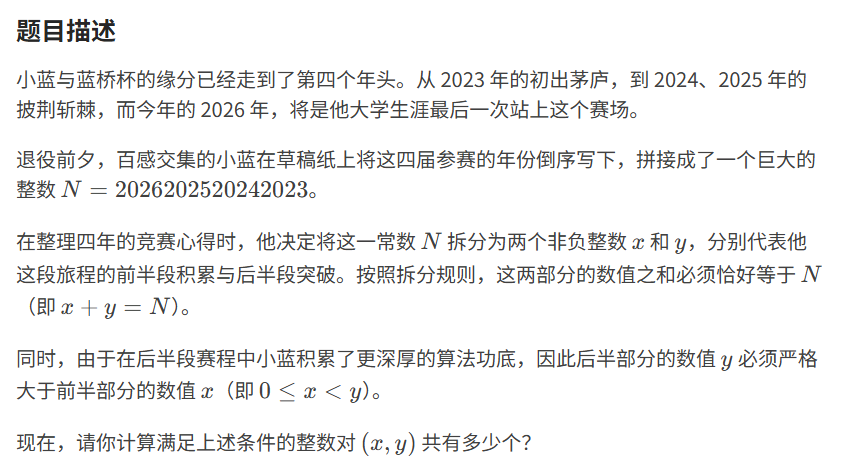
Problem Summary
The problem gives us the integer:
We need to count the ways to split it such that:
and:
Essentially, this is an integer-splitting counting problem. The concatenated years in the statement can be a distraction, but the problem does not ultimately involve splitting strings or any special construction.
My Thinking During the Contest
At first, I was distracted by the wording and thought “splitting” might have something to do with the string’s structure. After rereading it, though, I realized it should just mean writing the integer as the sum of two nonnegative integers, with the first strictly smaller than the second.
So we only need to count the possible values of . Since , the condition is equivalent to:
That is:
Since is odd, the valid values of are:
There are:
such values.
The Full Solution
Starting from:
set to obtain:
This becomes:
So the number of valid values of is:
Substituting:
gives the answer:
namely:
Accepted Code
Expand/collapse the final accepted code
1 |
|
Reflection
The problem itself is not difficult. What is worth recording is my first reaction during the contest. As the first fill-in-the-answer problem, I had expected it to be a fairly straightforward source of points. Yet immediately after reading it, I got caught up in “splitting” and the concatenated years, briefly thinking it might involve the string’s structure.
Getting slightly stuck on the very first problem does affect your mindset. Especially when I was already unsettled before the contest, not being able to confirm the first solution immediately made it easy to start wondering, “Am I off my game again today?”
Fortunately, I eventually reduced the statement to its simplest mathematical conditions: and . After that, the problem was just counting nonnegative integers satisfying .
On the first problem, keeping a steady head matters most.
T2: Dual-Carbon Strategy
Expand/collapse the T2 problem statement

Problem Summary
There are streetlights, all initially on. Each light can only be on or off, represented by and .
On odd-numbered operations, choose a light and toggle it and every light to its right—in other words, toggle a suffix.
On even-numbered operations, choose a light and toggle it and every light to its left—in other words, toggle a prefix.
For each possible final state, define the minimum number of operations needed to reach it from the initial all-on state. Find the sum of these minimum operation counts over all states, modulo .
My Thinking During the Contest
I spent about ten minutes looking at this problem during the contest but never found a useful starting point.
The operation rules were easy enough to understand. The difficulty was summing the minimum number of operations over all states. With states, considering them individually was clearly impossible, and I could not think of a brute-force approach either.
Without a workable model, I chose to skip it outright and did not return to it later.
The Full Solution
The key is to look at the relationships between adjacent lights—the “dividers”—rather than directly at each light.
Consider a final state:
where .
First, consider only whether adjacent lights differ. For each adjacent pair:
if they are the same, there is no boundary here; if they differ, there is a boundary. We can think of this boundary as a “divider.”
A sequence of lights therefore has internal divider positions.
Toggling a suffix does not change any adjacent relationship inside it, because that entire segment is inverted together. The only relationship that changes is the boundary immediately to the left of the suffix’s starting point.
Similarly, toggling a prefix leaves its internal adjacent relationships unchanged. The only one that changes is the boundary immediately to the right of the prefix’s endpoint.
So, apart from toggling the whole sequence, each operation can essentially be viewed as changing one internal divider position.
For now, consider just these internal divider positions.
Across all final states, any fixed internal divider position is in half the states and in the other half. In other words, each divider position contributes:
operations over all states.
There are internal divider positions, so their total contribution is:
But internal dividers alone are not enough.
The same internal divider configuration corresponds to two original sequences that are complements of one another.
For example, when , if the internal dividers are:
the original sequence can be:
or:
The adjacent changes are identical in these two sequences, but their overall on/off orientations are opposite.
For any fixed internal divider configuration, performing the corresponding divider operations reaches only one of the two complementary states. Reaching the other requires one additional toggle of the whole sequence.
Thus, each fixed internal divider configuration contributes extra operation.
The number of internal divider configurations is:
so the additional contribution from whole-sequence toggles is:
The total answer is therefore:
Combining the terms gives:
For this problem:
so the answer is:
We can calculate it with binary exponentiation.
Accepted Code
Expand/collapse the final accepted code
1 |
|
Reflection
What is most worth recording here is not why I failed to solve it, but why I did not keep grinding away at it during the contest.
As a fill-in-the-answer problem, it was worth a limited number of points. From its structure and its difficulty in hindsight, it was clearly beyond simple enumeration or a few simulation steps. I later saw that Luogu had marked it as a blue problem, which also suggests it was hardly a low-cost problem worth spending a long time on in the contest room.
After roughly ten minutes, I still had no workable model. Continuing to invest time would most likely have held up the later problems. Skipping it and not returning was closer to a locally optimal choice at that point.
Understanding its internal-divider counting and compensation for whole-sequence toggles afterward is exactly what a post-contest review should do. During the contest, though, the goal is to score as many points as possible in limited time, rather than prove that I can work out every problem.
The lesson here is about contest decisions rather than a particular algorithm template: when a problem is difficult, worth few points, and has no obvious entry point, cut your losses decisively.
T3: Cyclic Right Shift
Expand/collapse the T3 problem statement
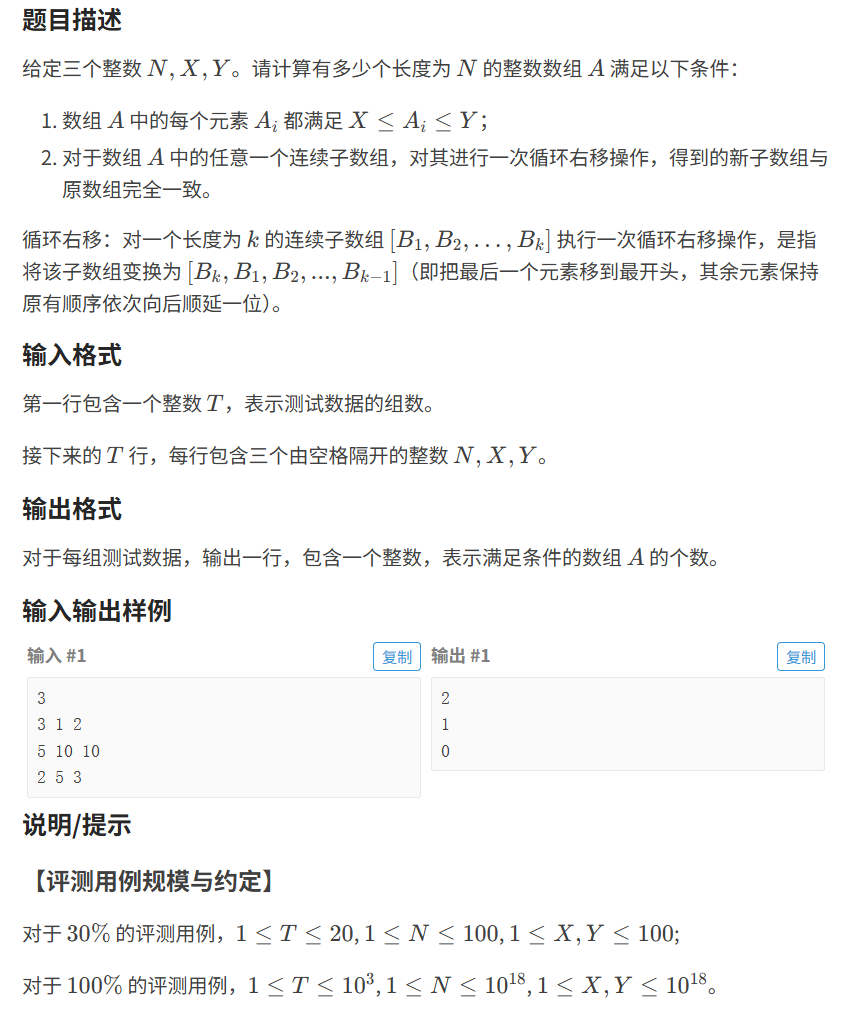
Problem Summary
Given , count the arrays satisfying the conditions.
Array has length , and each element must satisfy:
The entire array must remain unchanged after performing one cyclic right shift on any contiguous subarray.
Find the number of arrays satisfying this requirement.
My Thinking During the Contest
I did not actually give this a rigorous proof during the contest.
My judgment mostly came from the samples and intuition: an array satisfying the requirement probably had to have all its elements equal. If there were different elements, some cyclic right shift of a contiguous subarray would very likely change the original array.
On that basis, I simply assumed every valid array had to look like:
where:
So the answer was the number of choices for :
If , there are no valid choices, and the answer is .
I therefore wrote it as:
The Full Solution
The rigorous proof is actually very short: consider only contiguous subarrays of length .
Any two adjacent elements:
are themselves a contiguous subarray of length .
One cyclic right shift changes:
into:
The problem requires the entire array to remain unchanged, so the elements at these two positions cannot change. We must therefore have:
This holds for every pair of adjacent positions, so:
In other words, only arrays in which all elements are equal satisfy the condition.
The array must therefore have the form:
where:
The number of valid arrays is:
If , the answer is:
Both cases can be written together as:
Accepted Code
Expand/collapse the final accepted code
1 |
|
Reflection
During the contest, I reached the correct conclusion from the samples and intuition and wrote a full solution, but strictly speaking I had not completed the proof. Looking back, the real proof is very short. Although the statement requires the condition for every contiguous subarray, considering subarrays of length alone shows that all adjacent elements must be equal.
The lesson for me is that intuition can quickly point in the right direction, but if time allows, I should try to turn the key conclusion into a verifiable proof. In particular, conditions involving “any subarray” or “any interval” do not always require tackling the general case first. The smallest key structure may already be strong enough.
Solving this during the contest shows that my intuition was pointing the right way. From a review perspective, though, it also reminds me that fill-in-the-answer and conclusion-based problems should not stop at “this feels right.” Ideally, I should quickly find a minimal proof or contradiction that supports the conclusion.
T4: Lanqiao Esports
Expand/collapse the T4 problem statement
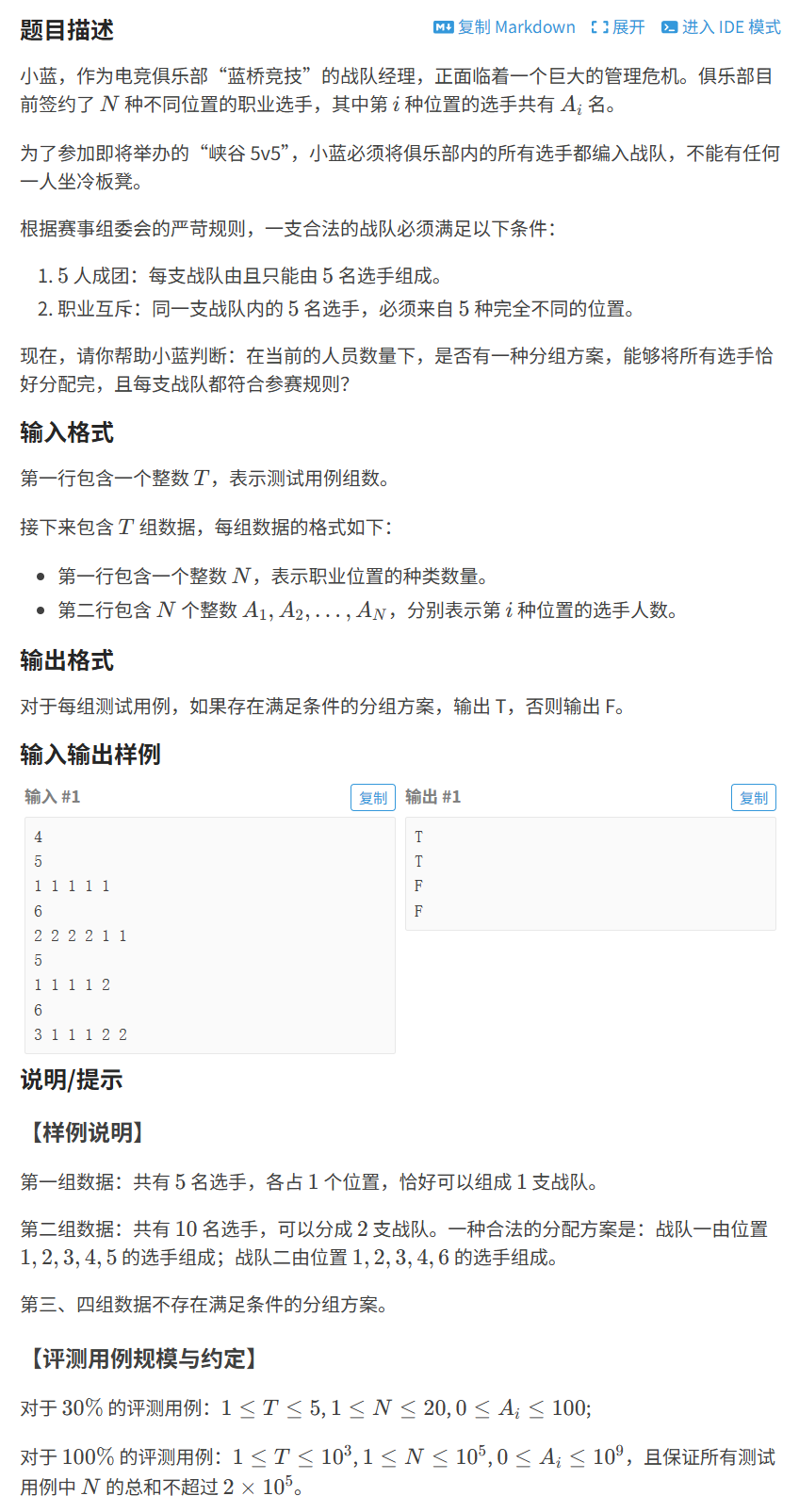
Problem Summary
There are types of playing position, with players in position .
We need to divide all players into teams, each satisfying:
- Exactly players.
- All players come from different positions.
In other words, no team can contain two players with the same position.
For each test case, determine whether every player can be assigned. Print T if so, or F otherwise.
My Thinking During the Contest
I did not immediately find a simple approach. After being stuck for a little under ten minutes, I decided to skip it for the time being.
Once I had dealt with the remaining problems I could write something for, I returned to this one. By then I was already starting to fall apart mentally. Instead of calmly analyzing necessary conditions and sufficiency, I treated it as an actual grouping problem and wrote a fairly complicated recursive / constructive approach.
The Full Solution
Let the total number of players be:
If every player can be assigned to valid teams, and each team has exactly players, we first need:
If this does not hold, assigning everyone is clearly impossible.
Let the eventual number of teams be:
Since each team can contain at most player of any given position, the players in position can be spread across at most teams.
We therefore also need:
That is:
These two conditions are necessary.
Next, we need to show that they are sufficient too.
Think of the teams as boxes. For position , since:
its players can always be put into distinct teams, without two players of that position ending up on the same team.
More intuitively, repeatedly take player from each of the different positions with the most remaining players to form a team. As long as the remaining total is a multiple of , and no position has more remaining players than there are remaining teams, no position will be forced to appear twice on the same team.
So the conditions to check are:
and:
Print T when both hold, or F otherwise.
Accepted Code
Expand/collapse the final accepted code
1 |
|
Reflection
I am not sure whether my contest code for this problem was completely correct. Looking back, the approach was clearly too complicated and missed the real heart of the decision problem.
I failed to recognize in time that this was a question of necessary and sufficient conditions. It could actually have been solved almost immediately, but I did not spot those conditions. Besides wasting a lot of time, this badly affected my mindset and pacing. That hurt.
On the surface, the problem talks about “grouping,” which makes it easy to instinctively start thinking about how to construct each team. But it only asks whether an assignment exists, not for the actual grouping. Being led astray by the “grouping process” was exactly why I wrote a complicated recursion whose correctness I was unsure of during the contest.
Redoing it afterward, the problem reduces to two conditions: whether the total is divisible by , and whether the largest position count exceeds the number of teams. The hard part was not writing the code, but trusting that these conditions were sufficient as well as necessary.
The lesson for me is that on problems asking “can these be grouped?”, “can this be arranged?”, or “does a solution exist?”, I should not jump straight into search or recursion. First check the total constraint, then the upper bound on any one category, and finally whether these necessary conditions are already enough. If I can make that abstraction first during a contest, many seemingly constructive problems can become very simple decision problems.
T5: LQ Aggregation
Expand/collapse the T5 problem statement

Problem Summary
Given a string of length containing only three characters:
LQ?
Each ? can be replaced with L or Q.
Define the string’s LQ aggregation count as the number of pairs satisfying:
and:
In other words, count pairs with an L before a Q.
Replace all the ? characters with L or Q to maximize the final string’s LQ aggregation count, and print that maximum.
My Thinking During the Contest
I did not actually derive the full solution during the contest.
At the time, I roughly guessed that the replacements for ? should tend toward L earlier and Q later, something like:
1 | LLLLQQQQ |
But I did not prove this conclusion during the contest or reliably turn it into an approach that enumerated a dividing point.
In the end, I wrote a greedy approach based on that guess. It was not rigorous and could probably only earn a small amount of partial credit on a few small test cases.
The Full Solution
First, consider a key conclusion:
In an optimal solution, the replacements for all
?characters can be viewed as an initial segment replaced withL, followed by a segment replaced withQ.
That is, considering the ? characters in the order in which they appear in the original string, an optimal pattern can always be written as:
1 | LLLL...LLQQQ...QQ |
There will not be an earlier ? replaced with Q and a later ? replaced with L.
We can prove this with an exchange argument.
Suppose two ? characters are at positions , with:
but their current replacements are:
This gives an inverted Q ... L pair.
If we swap them to:
these two positions themselves create one additional LQ pair. Meanwhile, among the characters between them:
- An intervening
Qcan contribute a pair with the newLon the left. - An intervening
Lcan contribute a pair with the newQon the right.
So swapping an earlier Q and later L to L ... Q cannot make the answer worse.
An optimal solution therefore has a dividing point: every ? before it becomes L, and every ? after it becomes Q.
The problem now becomes:
Enumerate this dividing point while efficiently maintaining the current number of LQ pairs.
One approach is to initially treat every ? as Q.
We can then calculate the current LQ count and call it cur.
Next, process the ? positions from left to right, changing the current ? from Q to L each time. This enumerates a new dividing point.
Suppose we are processing the -th ?, at position in the original string.
Changing it from Q to L affects the answer in two ways.
First, as a Q, it previously formed LQ pairs with all the L characters to its left. It is no longer a Q, so these contributions must be removed.
The L characters to its left come from two sources:
- Fixed
Lcharacters in the original string. - Earlier
?characters that have already been changed toL.
If we have already processed ? characters, the second part contributes characters.
The loss is therefore:
Here, the Chinese text in the formula means “the number of fixed L characters to the left.”
Second, as an L, it now forms new LQ pairs with all the Q characters to its right.
Since we initially treated all ? characters as Q and are changing the ? characters to L from left to right, the number of characters still acting as Q to the right of the current position can be obtained quickly from prefix counts.
Call this new contribution:
Each transition is then:
Take the maximum while enumerating all dividing points.
Each position is processed only a constant number of times, so the total complexity is:
Note that the LQ pair count can be as large as , so both the answer and the current contribution need long long.
Accepted Code
Expand/collapse the final accepted code
1 |
|
Reflection
What really blocked me during the contest was not maintaining the count afterward, but failing to rigorously derive the optimal replacement pattern for ?.
I had a vague sense that the answer should consist of “a segment of L followed by a segment of Q,” but without proving it, I was on shaky ground and could only continue with an unjustified greedy approach. Looking back, if I had confirmed the pattern with an exchange argument, the rest would naturally have become enumerating the dividing point and calculating the answer with prefix sums or incremental updates.
That is also what happened when I redid it afterward. Once I realized the ? replacements could be divided by a single boundary, the modeling and code followed from there. Initially treating every ? as Q, changing them to L one by one from left to right, and maintaining lost and gained contributions at each step is not an especially convoluted implementation.
The issue exposed here is clear: I was not completely lacking in algorithmic ability, but I missed the step of turning an “intuitive pattern” into a “provable structure” under contest conditions. For this kind of optimal-construction problem, if a certain answer pattern feels right, I should prioritize proving it with an exchange argument. Once the pattern is proved, an uncertain greedy idea often turns into a definite model that can be enumerated.
T6: Emergency Cabling
Expand/collapse the T6 problem statement
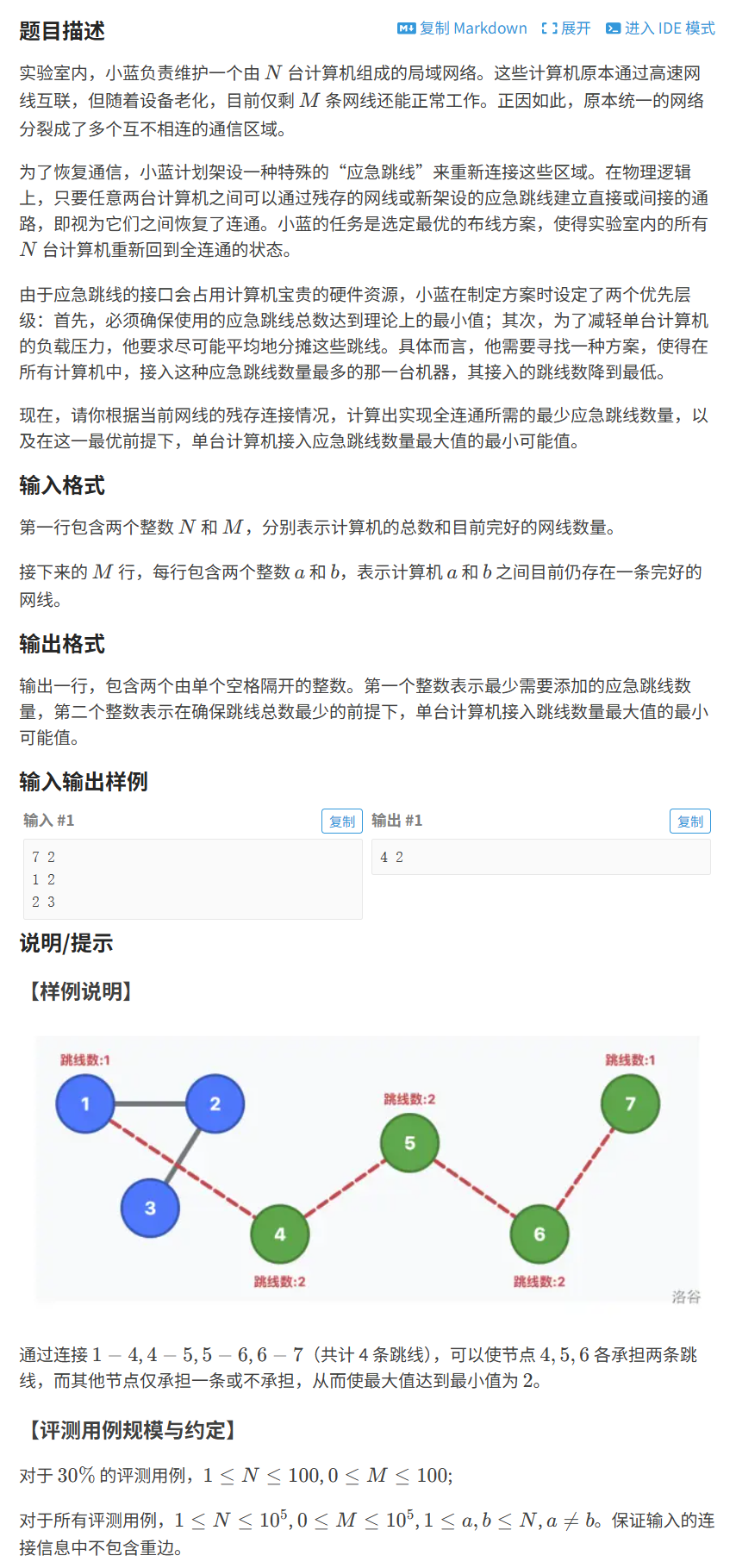
Diagram guide: Solid gray lines are existing cables; dashed red lines are the four new patch cables, connecting 1–4, 4–5, 5–6, and 6–7. The red label “跳线数” means “number of new patch cables attached”: computers 4, 5, and 6 each take two, and the maximum is 2.
Problem Summary
There are computers and existing cables. Treat computers as vertices and cables as undirected edges; the current network may be disconnected.
We can add emergency patch cables to make the entire network connected.
Print two values:
- The minimum number of patch cables that must be added to connect the entire network.
- Subject to adding that minimum number, the smallest possible maximum number of new patch cables attached to any single computer.
My Thinking During the Contest
The first part is straightforward: count the connected components. If there are components, we need at least:
new edges to connect all of them.
The main trouble was the second part.
During the contest, I tended to think of the new patch cables as a “star”: find a sufficiently large connected component to serve as the center and connect it to all the others. My thinking therefore focused on the largest component’s size. If it contained at least computers, it seemed possible for different computers in that central component to each take one cable, keeping the maximum number attached to a computer at .
This covers some cases, but it assumes an optimal solution must resemble a star. Looking back, that assumption was incomplete.
The Full Solution
The first part still comes down to the number of connected components.
If the current graph has components, making the entire graph connected requires at least:
new edges.
Each new edge can merge at most two components into one. Merging components into one therefore requires at least connections. At the same time, connecting the components as a tree achieves it with edges.
So the answer to the first part is:
Now consider the second part.
With the number of new edges minimized, it is fixed at:
Each new edge has two endpoints, giving a total of:
new patch-cable endpoints.
Essentially, the second part asks us to distribute these endpoints as evenly as possible among the computers, minimizing the largest number assigned to one computer.
The answer is therefore at least:
This lower bound can be achieved.
If:
all new endpoints can be assigned to different computers, so the answer to the second part is .
If:
at least one computer must take two new endpoints. Since , the answer in this case cannot exceed . For example, connect all components in a chain: each component takes at most two connection endpoints, and every component has at least one computer that can take them.
When , the original graph is already connected and no new edges are needed, so both answers are . The formula:
naturally gives in that case too.
The second answer can therefore be written uniformly as:
In code, use integer ceiling division:
That is enough.
Connected components can be counted with DFS / BFS or a disjoint-set union structure. I use an adjacency-list graph and BFS here, because I have not learned disjoint-set union yet.
Accepted Code
Expand/collapse the final accepted code
1 |
|
Reflection
I probably earned most of the points for this problem during the contest. The connected-component calculation in the first part was sound; the real issue was my understanding of the structure in the second part.
My thinking leaned toward a star: use the largest connected component as the center and have it connect to every other component. If that largest component contains at least computers, its computers can indeed each take one new patch cable, making the maximum attachment count .
But this is sufficient, not necessary. An optimal solution need not be a star; it can be a chain or another tree structure. For example, several components can share the new endpoints rather than placing the burden of every edge on a single central component.
The full solution’s perspective is simpler: the minimum number of new edges is fixed at , so the total number of new endpoints is fixed at . The second part asks us to spread these endpoints as evenly as possible across all computers, rather than find a center.
My lesson here is that when a problem asks us to “minimize the maximum load while adding as few edges as possible,” I should not rush to assume a specific structure, such as a star. First look at total resources and total load, then determine whether the average-based lower bound is achievable. The abstraction I missed in the contest was shifting from “find a central component” to “count the new endpoints and distribute them.”
T7: Ideal Temperatures
Expand/collapse the T7 problem statement
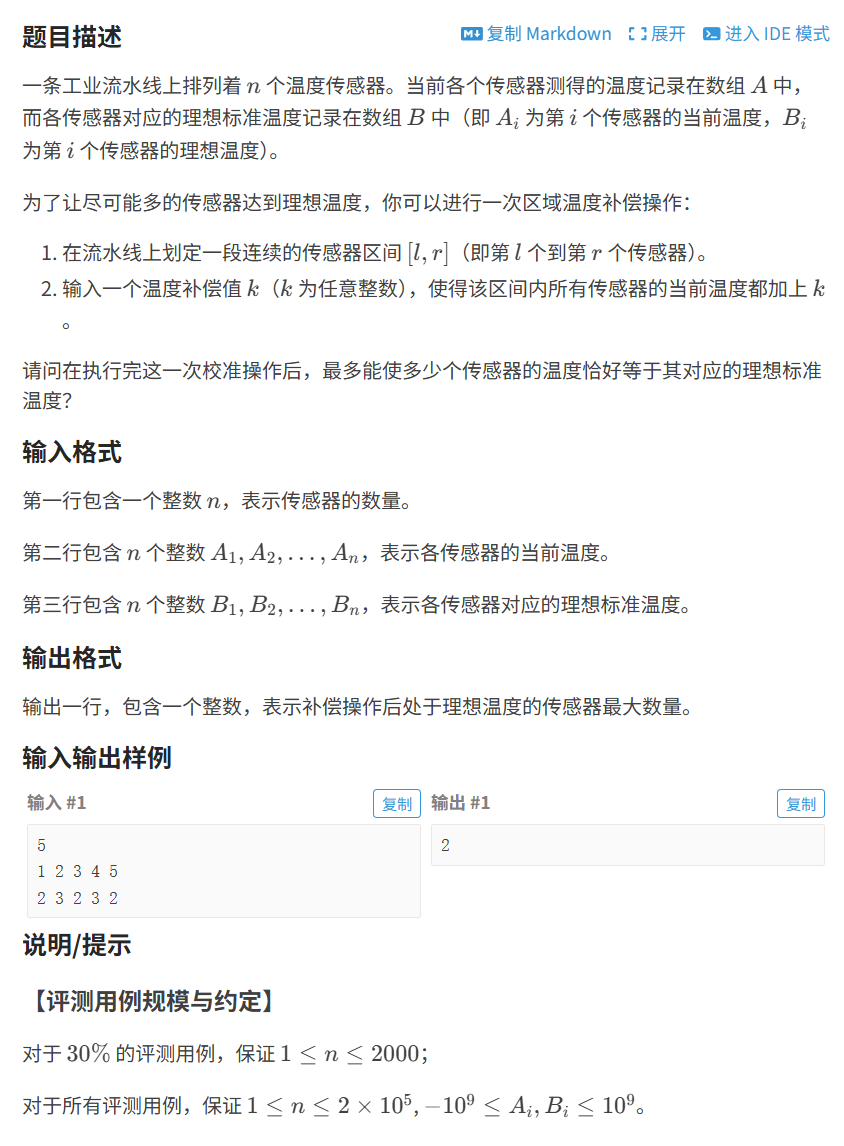
Problem Summary
There are positions. Position has current temperature and ideal temperature .
We can choose a contiguous interval and add the same integer to every temperature in it.
After the operation, a position reaches its ideal temperature if:
Positions outside the interval remain unchanged.
Find the maximum number of positions that can reach their ideal temperatures after at most one such operation.
My Thinking During the Contest
My contest approach began by calculating the difference at each position:
If we choose an interval and add , only positions in that interval with will reach their ideal temperatures.
Based on this, I recorded the range over which each difference occurred and divided the whole array into three parts: before the interval, inside it, and after it. I then compared the number of positions already at their ideal temperatures with the benefit of adjusting the interval covering every occurrence of a particular difference.
But halfway through writing it, I already realized the idea was incomplete.
If two occurrences of a difference have many positions with between them, those positions are already at their ideal temperatures, and covering them with a nonzero makes them wrong. So an interval covering all occurrences of a difference is not necessarily optimal; the true optimum may cover only a subset of its occurrences.
By then, I did not have enough time to rebuild the model and derive the full solution. I could only keep writing along this incomplete line of thought and try to get some partial credit.
The Full Solution
Again, first define the differences:
If , that position is already at its ideal temperature. Call the number of such positions:
Without any effective adjustment, the answer is at least .
Now consider an operation that adds some nonzero integer .
Each position in the interval falls into one of three cases:
- If , the position changes from incorrect to correct, contributing .
- If , the position was correct but becomes incorrect after adding nonzero , contributing .
- If and , the position is incorrect both before and after, contributing .
For a fixed , the problem therefore becomes:
Choose a contiguous interval with maximum total gain in a sequence consisting of .
This is the maximum subarray sum model.
However, we cannot scan the entire array for every , or the complexity would deteriorate to .
For a fixed , notice that only positions with give a positive contribution. Other nonzero differences unequal to contribute , and only positions with give a negative contribution.
So we can store the occurrence positions of each nonzero difference and run a “sparse maximum subarray sum” over those positions alone.
Suppose a particular difference occurs at:
Each itself contributes .
If the previous occurrence and the current occurrence are included in the same interval, any positions with between them give negative contributions.
Use a prefix array to count positions with . Then:
is the number of positions between and that were originally correct.
The sparse maximum-subarray-sum transition is therefore:
Here:
- means start a new interval at the current position.
- means extend the preceding optimal segment: the current contributes , while intervening positions with contribute negatively.
Calculate the maximum gain for every nonzero difference . The final answer is:
Each nonzero position belongs to exactly one difference group, so the total processing across all groups is . Using unordered_map to store the occurrence positions of each difference gives average complexity:
Accepted Code
Expand/collapse the final accepted code
1 |
|
Reflection
This was one of the problems I spent longer on in this review. It was not that I was completely unaware of the issue during the contest. I had already noticed that “cover every occurrence of the same difference” was wrong, because intervening positions become negative contributions, so the optimal interval might cover just a portion of them.
But noticing that the original idea is wrong and abstracting a correct solution afresh during a contest are two different things.
The real transformation is to fix a nonzero difference , turn each position’s effect into , and then find a maximum subarray sum. Since scanning the whole array for each is too expensive, we must go further and compress this into a sparse maximum subarray sum that visits only occurrences of that difference.
Even after the contest, these layers of abstraction took me quite a while. With so little time left during the contest, it was essentially impossible for me to derive them all. So I think it was acceptable to continue with the partial-credit approach I had already half written and submit it.
The lesson for me is that if I already know an approach is incomplete during a contest, but cannot rebuild the model quickly, I should decisively cut my losses and secure the partial-credit solution I can write. What I really need to improve afterward is recognizing models: when I see “choose an interval, with some positions adding points and others subtracting them,” maximum subarray sum should come to mind quickly.
T8: Football Training
Expand/collapse the T8 problem statement
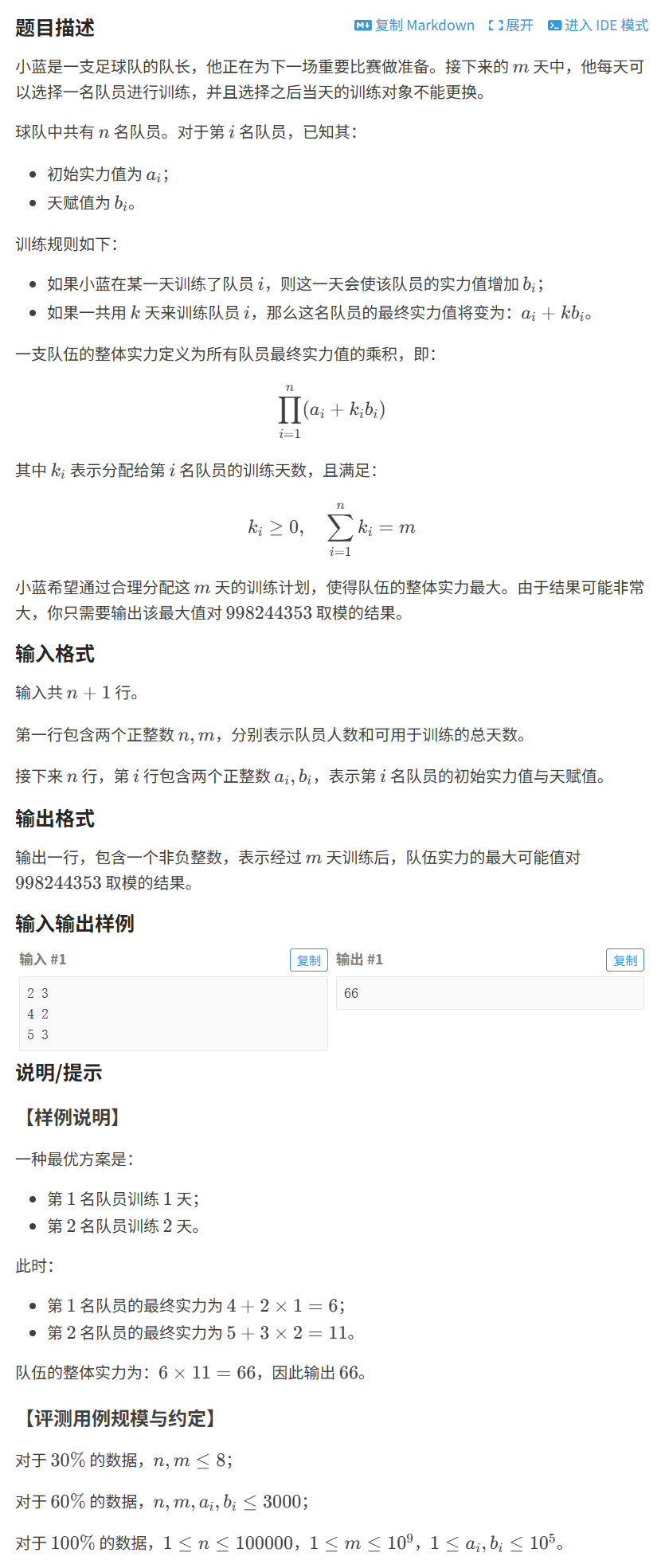
Problem Summary
There are players. Player starts with ability and gains ability for each day of training.
We have training days to distribute among the players. If player trains for days, their final ability is:
with:
Maximize the product of all players’ final abilities:
and output it modulo .
My Thinking During the Contest
As this was the final problem, I did not consider a full solution during the contest.
My strategy was clear: write a DFS brute force to enumerate training-day allocations and try to earn at least partial credit. For small inputs, enumerate how many training days each player receives and calculate the maximum product.
This was not a complete solution. But for the hardest final problem, without any idea of the full solution, first writing something to secure the available partial credit was a realistic choice.
The Full Solution
The key is to turn “allocate training days to maximize a product” into “the marginal gain from each day of training.”
Suppose player has already trained for days. Their current ability is:
One more day of training makes it:
The overall product is then multiplied by:
This multiplier is the marginal gain from training that player for one more day.
Rearranging it:
we can see that as increases, the denominator increases, so the marginal gain from continuing to train the same player gradually decreases.
In other words:
The more training a player has received, the less worthwhile it becomes to train them further.
The optimal strategy can therefore be understood as:
Select the largest gains from all players’ possible “next day of training” gains.
If were small, we could use a priority queue and repeatedly give one day of training to the player with the largest current marginal gain. Here, though, is too large to simulate one day at a time.
To process training in bulk, we introduce a “water-level” model.
Write ability as:
Here is fixed. Let:
We can think of as player ‘s current “water level.”
Each day of training increases that level by .
From the marginal-gain formula:
we can see that a lower level means a larger marginal gain from the next training day.
The problem is therefore equivalent to selecting the smallest levels from all the sequences:
Next, binary-search for a safe threshold level .
For a player , if:
the level corresponding to this training day does not exceed , so we can select it in advance.
The values of satisfying this are:
This player therefore receives:
training days under threshold .
Summing this over all players tells us how many training days the current threshold would select.
During binary search, maintain a threshold that is as high as possible while selecting no more than training days. Once the search ends, use the threshold to calculate each player’s in bulk, then count the unallocated days and call that number rest.
Because levels can be tied, the threshold found by binary search usually cannot select exactly training days. We therefore need a priority queue to allocate the remaining days.
At this point, each player’s next training day corresponds to level:
Repeatedly remove the player with the smallest current level from the priority queue, give them one training day, update their level, and put them back, until all rest remaining days have been allocated.
Finally, each player’s training allocation is fixed, so simply calculate:
to obtain the answer.
Accepted Code
Expand/collapse the final accepted code
1 |
|
Reflection
I admit that this was a problem I genuinely did not know how to solve during the contest.
Unlike some earlier problems, I was not just one proof or one abstraction away, nor was it just a matter of an unreliable implementation. Its full solution is difficult from the modeling stage onward: first recognize the allocation as a question of marginal gains, then observe diminishing marginal gains for each player, and finally turn that into the water-level model.
Even after noticing that “the more a player trains, the less worthwhile additional training becomes,” the implementation is far from easy. Binary-searching the threshold, using floor to count training days, handling the +1 boundary, filling the remaining days with a priority queue after binary search, and preventing overflow in the final product—an error in any one of these details can give a wrong answer.
I spent a long time reviewing this problem afterward too. What eventually let me write it was breaking it down little by little: first understanding diminishing marginal gains; then why “select the largest gains” is equivalent to selecting the smallest levels; then why binary search can only allocate most training days in bulk; and finally using a heap to finish the boundary cases.
So I think writing DFS brute force directly during the contest for partial credit was reasonable. If the final problem offers no visible route to a full solution in a short time, securing the small-input partial credit first makes more sense than burning time on it.
This problem deserves revisiting. The lesson is that maximizing a product can often be approached through marginal gains. If those gains are monotonic, the problem may turn into a greedy algorithm, binary search on the answer, or priority-queue maintenance. I cannot yet say I have a truly practiced command of this problem, but this review has at least filled in the main ideas and crucial implementation details for me.
Reviewing the Contest as a Whole
Across the contest, I more or less held steady on two or three problems and earned some partial credit on the difficult ones at the end. But my performance on several middle problems that I was fully capable of solving was inconsistent.
What Held Up
Although I am very dissatisfied with how I performed, the result and the review show that this contest was not a complete loss of control.
First, I did hold steady on some problems. T1’s wording distracted me at the start, but I eventually reduced it to counting integer splits in time, without letting that initial hesitation keep interfering with my judgment. On T3, I did not produce a rigorous proof during the contest, but intuition caught the key conclusion that “every valid array must have all elements equal,” and the direction was correct. The connected-component calculation in T6’s first part was solid. Although my mistaken star-shaped model blocked the second part, I at least understood the main idea that “the number of components determines the number of added edges,” which was enough for most of the points.
Second, I made some fairly reasonable tradeoffs. I skipped T2 after about ten minutes without an idea, instead of continuing to pour time into it. On T8, the final problem, I saw no way into the full solution and immediately wrote DFS brute force for small-input partial credit. Looking back, these choices were reasonable. Not every problem is worth grinding away at during a contest, especially difficult fill-in-the-answer problems and the final problem. If no workable model appears quickly, knowing when to cut losses is an ability in itself.
Also, even where I did not solve a problem fully, I was not drawing a complete blank. On T4, despite a collapsing mindset and time pressure, I still wrote a cumbersome recursion that could earn some partial credit. On T7, although I did not derive the maximum-subarray-sum model, I recognized the relationship between differences and interval adjustments, and I knew covering the entire interval was not rigorous; judging from the result, it seems I received a small amount of credit there too. T8 at least earned the available partial credit through brute force.
Overall, I did plenty of things poorly, but I preserved a baseline: the basic problems did not fall apart across the board, I knew to cut losses on difficult problems, and apart from guessing an answer on T2, I tried to submit something that could score on every problem. Together, these produced the provincial first prize.
What Did Not Hold Up
What disappoints me most is that on many problems, I was not completely without direction—I failed to hold things together at the crucial step.
Although T1 ended correctly, getting caught by the statement on the very first problem already showed that my contest condition was less than ideal. I should have confirmed and cleared the first fill-in-the-answer problem quickly, but instead I was briefly distracted by “splitting” and the concatenated years. That slight hesitation did not directly lose points, but it did affect my mental state afterward.
Although I got T3 accepted, I did not find a rigorous proof. I should have been able to prove a problem at this difficulty.
T4 was the clearest mistake. Redoing it afterward showed that it only required two checks: whether the total number of players was divisible by , and whether the largest position count exceeded the number of teams. It could have been solved quickly, but I missed the necessary and sufficient conditions during the contest. Instead, “grouping” led me into complicated recursion and construction. This wasted time and clearly disrupted my pacing.
On T5, the problem was failing to derive the optimal replacement pattern for ?. Once it is proved that the ? replacements can always consist of a segment of L followed by a segment of Q, enumerating the dividing point and maintaining the count incrementally follow naturally. During the contest, though, I only vaguely guessed the pattern, did not prove it, and did not have the confidence to keep pursuing it. The resulting greedy approach lacked rigorous justification and could only get partial credit on some small cases.
For T6’s second part, I assumed the optimal structure was a star. That covers some cases, but it is a sufficient condition, not a necessary one. The full solution should start from the total number of new endpoints, spreading endpoints as evenly as possible among computers. I failed to move promptly from a specific construction to the total-count constraint. In fact, I had solved most of the problem; I was missing just that final push over the line.
T7 was a different kind of issue. I knew my original full-interval idea was wrong, and I knew positions with would contribute negatively, but I no longer had time to rebuild the model. It was only in the post-contest review that I saw the right transformation: “sparse maximum subarray sum for each fixed difference.” This shows that even when I get close to the full solution during a contest, I may still fail to recognize the right model under time pressure.
On T8, I simply did not know the full solution. Diminishing marginal gains, binary search on a water-level threshold, and filling the rest with a priority queue were things I was essentially incapable of deriving completely during the contest. Brute force for partial credit was a reasonable choice, but in terms of ability, the problem exposed insufficient command of more advanced greedy reasoning, bulk allocation through binary search, and implementing complicated boundaries.
Overall, the core issue was not simply “being unable to code.” Several crucial abstractions never happened: reducing T4 to necessary and sufficient conditions, proving T5’s answer pattern, escaping T6’s star construction, recognizing maximum subarray sum in T7, and, for T8, handling a model and implementation that were both beyond my in-contest ability.
The Issues This Exposed
Taken together, these problems show that my biggest current weakness remains this: sometimes I can find a direction, but under contest pressure I cannot turn it into a dependable, provable, implementable full solution.
1. My Abstract Modeling Is Still Inconsistent
On many problems, I was not completely directionless. I was missing the final layer of abstraction.
Some require moving from a concrete construction to necessary and sufficient conditions; some from a local greedy idea to a proof of the answer’s structure; others from interval operations to a gain model. Redoing the problems afterward, I can often work through these transformations slowly. In a contest, however, time is limited and pressure is high. If my first instinct goes wrong, it is easy to remain stuck with an incomplete idea.
2. I Do Not Pay Enough Attention to Proof
Sometimes I can intuitively guess a conclusion during a contest, but do not prove it in time.
Intuition is certainly important in competitions, but a conclusion without a proof is hard to build an implementation on. In particular, for optimal structures, necessary and sufficient conditions, and greedy correctness, I need to find a proof that convinces me quickly, or the code will rest on shaky ground.
3. My Implementation Details Still Fall Short of Consistent Acceptance
Even after understanding some ideas afterward, I still repeatedly get stuck on details when actually coding them.
Examples include maximum-subarray-sum transitions, prefix-count boundaries, floor and +1 in binary search, and preventing overflow in modular multiplication. This shows I have not practiced some models to the point of “seeing them and coding them reliably.” There is still a gap between understanding an idea and consistently getting it accepted.
4. My Contest Mindset and Pacing Are Still Unsteady
When I get stuck on an early problem, it noticeably affects my mindset.
Some problems should not take much time, but getting stuck on them disrupts the pace of everything that follows. A contest tests more than the ability to solve problems. It also tests whether I can promptly decide: should I keep thinking about this problem, is this approach worth implementing, and at what point should I cut my losses?
5. My Partial-Credit Strategy Is Still Immature
I did write partial-credit solutions on some problems this time, and did not leave the later complicated problems completely blank. Looking back, though, I still have not truly learned to “scrape together points reliably.”
Reliable partial credit does not mean casually writing a wrong greedy algorithm. It means using the stated constraints and partial properties to write an approach that is as dependable and controlled as possible and covers a subset of test cases. When the full solution does not come immediately during a contest, designing a partial-credit approach I can have high confidence in is another skill I need to train.
Overall, this provincial first prize shows that I have some foundations and a baseline, but it also exposes the gap between where I am and more consistent competitive ability. What I need next is not one isolated piece of knowledge, but a whole set of abilities: abstract modeling, proving conclusions, implementation details, contest pacing, and reliably earning partial credit when I cannot solve a problem fully.
Closing Thoughts
A provincial first prize. 25th in Beijing.
In terms of results, this is already a good enough milestone. The award also has a special meaning for me—it seems to affirm that I have emerged from the gloom of the past two or three years.
After reviewing the entire paper, I also know clearly that I am unhappy with my performance. That is why I was so dejected when I walked out of the contest room. I felt my performance might only be enough for a provincial third prize, perhaps a second prize with some luck. Many problems were within reach, but I was stuck on points I should have worked through. Some could have been solved faster, but their wording or my mindset led me astray. On others, I wrote partial-credit approaches without making that scoring genuinely reliable and controlled.
So to me, this first prize is more a confirmation of progress than an endpoint.
It confirms that the effort I have put into something I love has not been wasted; that more than half a year of building algorithm knowledge, practicing problems, reviewing them on the blog, and preparing for this contest was not in vain. It also shows that I still have a baseline even when I am not in a good state.
But it also reminds me how much I still need to mature in mathematical derivation, structural transformations, awareness of proof, implementation details, and consistency during contests.
The provincial contest is over. However many regrets I have, I cannot keep dwelling on the emotions of reviewing it. The point of a review is not to keep proving how badly I did, but to identify the problems and take them into the next stage of training.
The next practical goal is the national contest. Even counting generously, there is only about a month left.
I need to adjust quickly and get back into a preparation rhythm. That means learning some algorithm topics I have not covered yet, addressing the gaps and weaknesses I have identified, and continuing to practice timed contest simulations, partial-credit design, and contest decisions.
I will keep going, with the same love for it as ever :)